When Deep Learning Stops at the Document
A Note
Lately, the term deep learning has been everywhere. It appears in curriculum documents, in teacher training sessions, in education seminars. Everyone talks about it. Everyone nods. Everyone agrees that learning must go deeper, become more meaningful, more relevant.
And we read all of this with mixed feelings. Happy, of course. Because ideas we have lived by have finally been given a name, a stage, recognition from policymakers. But also uneasy. Because we know, from long experience in education, that there is an enormous distance between a concept written in a document and a concept that actually comes alive in a classroom.
Curriculum Documents Have Never Taught a Child
Michael Fullan, Joanne Quinn, and Joanne McEachen wrote in Deep Learning: Engage the World Change the World (2017) a sentence that should make all of us pause: “Programs don’t scale; culture does.”
They also note, honestly, that new curriculum documents rarely say much about how to implement the competencies they proclaim, let alone how to assess them. A document writes what should be achieved, but rarely answers how to achieve it in a real classroom, with real children, in all their complexity.
This is not a criticism of policymakers. It is an acknowledgment that regulation, however good it may be, has never taught a child. What teaches a child is a teacher. What shapes a child’s learning experience is school culture. What determines whether a concept lives or dies is what happens every morning when the classroom door opens.
Fullan writes bluntly: “The change lesson here is that we need to change the culture of learning, not simply the trappings or structures. It cannot be done by policies or mandates.”
What Happens When Deep Learning Is Truly Alive
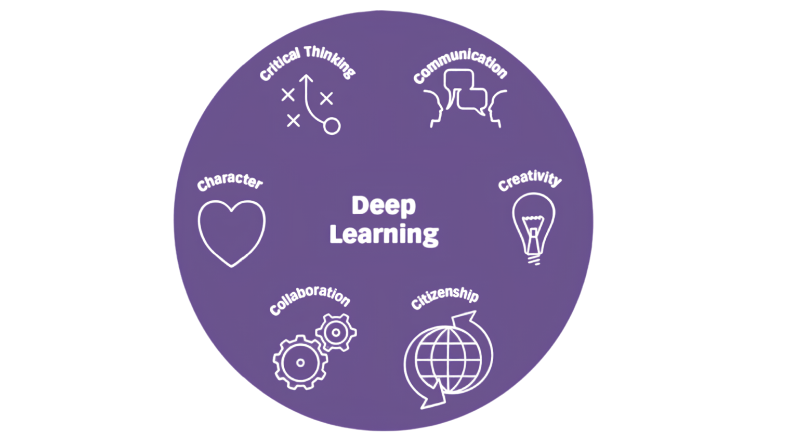
Fullan built the deep learning framework around six global competencies: Character, Citizenship, Collaboration, Communication, Creativity, Critical Thinking (the 6Cs). But what makes deep learning different from a mere list of competencies is this: it permanently changes the roles of students, teachers, families, and communities.
In the classrooms he visited across seven countries, Fullan witnessed children who had been disengaged suddenly leading community projects. Children who had been afraid to speak now presenting to hundreds. Teachers who had once stood at the front as the sole source of knowledge now saying, “We are partners.”
And most importantly: none of this happened because of a new regulation. It happened because the culture of learning changed. Because children were given space to ask, to fail, to try again. Because teachers were trusted not merely to deliver content but to build understanding together. Because schools allowed uncertainty as part of the process.
In places where this has long been lived, not because it is trending, but because it is believed, deep learning is not a new concept. It is the air people breathe every day. A child who learns to own a mistake is building character. A child who works across ages is building collaboration. A child who asks “why?” without fear of being judged is building the curiosity that will carry them through a lifetime.
What We Worry About
Fullan voices the same worry we carry. He writes that the deep learning movement “is fragile and may become domesticated by strong forces in the status quo, or become weakened because the work becomes too complex and hard.”
And we understand why. Because genuine deep learning demands something very difficult: letting go of control. It demands that teachers no longer be the sole holders of answers. It demands that schools no longer measure success by numbers alone. It demands that systems trust children can learn without being forced, directed, and standardized.
So the question we should be asking is no longer “Does our curriculum include deep learning?” That is no longer the question. The question is: “Is deep learning happening in our classrooms today? Are our children truly experiencing learning that goes deep, or are they still sitting in rows, listening, copying, and answering questions they never understood?”
An Invitation
To policymakers, we want to say: a good curriculum document is an important beginning. But it is never enough. What transforms education is not a document. What transforms education is a teacher who feels trusted, a child who feels valued, and a school culture that allows everyone to learn, to fail, and to grow.
To parents, we want to say: if you hear the term deep learning at your child’s school, ask one simple question: does my child experience this every day, or do they only hear it as a slogan? Because genuine deep learning is visible. It is visible when a child comes home with new questions, not just answers. When a child talks about what they discovered, not just what they memorized. When a child is not afraid of being wrong, because they know that at their school, being wrong is part of learning.
True deep learning does not wait for a curriculum to tell it that learning must go deep. It has already begun. Every day. One child at a time.
Antonius Widitrianto
“Deep learning is different in nature and scope than any other education innovation ever tried. It changes outcomes… character, citizenship, collaboration, communication, creativity, and critical thinking; and it changes learning by focusing on personally and collectively meaningful matters, and by delving into them in a way that alters forever the roles of students, teachers, families, and others.”
— Fullan, Quinn, & McEachen, Deep Learning: Engage the World Change the World (2017)
Reference
Fullan, M., Quinn, J., & McEachen, J. (2017). Deep Learning: Engage the World Change the World. Thousand Oaks, CA: Corwin.
Posted on 14 August 2026